
A Second Set of Eyes: What Guide Dogs Offer the Visually Impaired
June 1, 2026
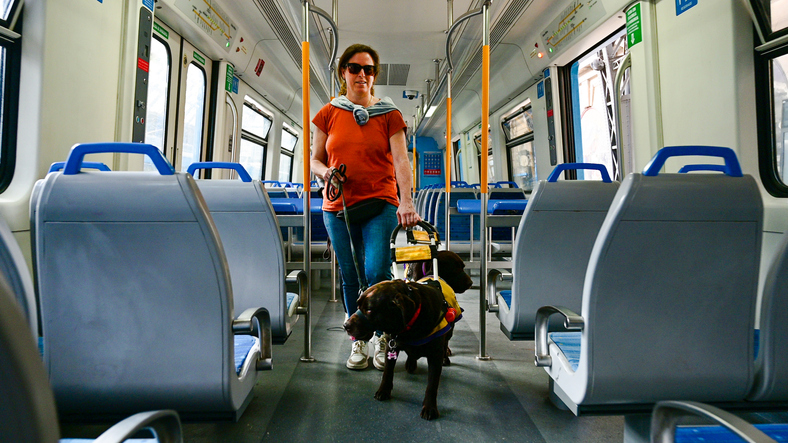
In the late 1920s, an article called “The Seeing Eye” was published. It told Americans about a successful guide dog training program for WWI soldiers in Germany. Letters poured in from readers, asking where they could find a guide dog of their own. A century later, there are an estimated 10,000 guide dog teams currently paired together in the United States alone. Guide dogs not only offer people with visual limitations greater independence but also companionship.
If you’re thinking about being paired with a guide dog, then here’s everything you need to know.
Who Qualifies?
There are several organizations that train and pair guide dogs, and they all have similar requirements. With The Guide Dogs of America, or GAD, individuals qualify for a guide dog if they are legally blind, 18 years old or over, and financially able to care for a guide dog. Applicants must also be able to walk 1-2 miles a day, or at least 30 minutes without stopping, independently or with a cane.
Training in orientation and mobility (O&M) is also required. O&M is training that helps visually impaired individuals navigate the world with confidence. It involves sensory and spatial awareness, searching skills, independent movement, and protective techniques. Every potential guide dog applicant must submit an O&M evaluation before being accepted into a training program.
What to Expect at Training
After an application is received, an instructor will reach out to the applicant for an interview. This is to get to know them and their lifestyle, so they can match individuals with the right dog.
Once individuals are accepted into the program, they are placed in the next class at the training campus. There, students will learn how to interact and work with guide dogs. Applicants are considered prospective guide dog handlers and therefore require training.
Before a guide dog is officially paired with its handler, an emotional bond must form between them. The right match is important so that they both feel safe with one another and can develop a deep level of trust.
“I wanted to expand my mobility ambitions rather than shrink them,” says Mike Brace, a paralympic skier who used a cane for many years. He was eventually paired with guide dog Izzy. “Izzy has allowed me to do more,” says Brace. “She gives me freedom of movement and independence. I can go anywhere with her and know that I will be able to find my way.”
To find a compatible training center nearby, the International Guide Dog Federation has a search-friendly database of training centers worldwide.
Benefits of Having a Guide Dog
While a guide dog’s primary purpose is to help its handler get from point A to point B, its assistance goes well beyond that. Having a guide dog brings new opportunities for social outings and interactions for its owner, resulting in greater self-confidence.
These highly trained dogs can help their owners travel safely using a skill known as obstacle avoidance. They help the handler navigate unexpected obstacles, such as a trash can or a blocked sidewalk. Another skill they use is traffic awareness, in which a dog will refuse to move forward if there is oncoming traffic. These guide dogs are so intelligent that they can disobey their handlers in certain instances, such as these, to keep them safe.
The dogs are also trained to spot essential landmarks, which are locations their handler will encounter in daily life. This means being able to go into a restaurant and quickly find the front counter and restrooms. Other landmarks include crosswalk poles with traffic buttons, benches or chairs, elevators, and exits.
For many visually impaired people, guide dogs can be a vital lifeline to more mobility and independence, but they also become family members. “You build up a very strong bond, being with it 24/7,” says John Welsman, a UK resident currently guided by a dog named Breck. “The dog is not only your mobility aid, it is your companion and communication aid.”
Guide dogs are also in a caregiving role. They learn to read unspoken signals, such as changes in posture or facial expressions, and can tell if their handler needs something. This creates a deep level of trust between them. “Assistance dogs care for humans, and humans also do their best to care for their assistance dogs,” says Suvi Satama, a professor at the University of Turku who studies the caregiving role of guide dogs. “In this way, vulnerability becomes relational, and both parties give and receive care.”