
Category: Caregiving
Finding Your Muse: Music and Memory in Alzheimer’s Patients
September 1, 2026

Watching a loved one slowly lose pieces of their memory due to Alzheimer’s can be devastating. According to the Alzheimer’s Association, more than 7 million people in the U.S. are affected by this progressive disease, robbing them of critical thinking abilities. A growing body of scientific evidence now suggests that listening to music activates neural regions associated with memory, which is welcome news for Alzheimer’s patients and their caregivers.
Researchers from Monash University in Australia conducted a long-range study of over 10,000 people aged 70 and older and found that listening to music daily reduced the risk of developing dementia by nearly 40%. The group that was followed for 10 years also showed a 33% lower risk of dementia in those who played a musical instrument. “Our study suggests that lifestyle-based interventions, such as listening to and/or playing music, can promote cognitive health,” says Joanne Ryan, senior author of the study and head of the Biological Neuropsychiatry and Dementia research unit at Monash.
How does Alzheimer’s affect the brain?
Alzheimer’s is the most common form of dementia and is characterized by a slow decline in cognitive functioning due to a buildup of tau and amyloid proteins. As the disease progresses, healthy neurons in the brain lose their connections with one another and die, leading to memory loss over time. The disease typically starts in the brain region responsible for memory and ends in the brainstem, affecting critical heart and lung functions.
Some patients may have difficulty remembering the faces of their loved ones and may find their usual environment confusing and disorienting. For such patients, being exposed to familiar experiences and keeping the brain engaged and active is vital to slow the progress of this irreversible disease. “Personalized music programs can activate the brain, especially for patients who are losing contact with their environment,” says Norman Foster, MD, Director of the Center for Alzheimer’s Care and Imaging Research at the University of Utah Health.
What is the connection between music and memory?
Studies show that music that evokes certain emotions can allow people affected by Alzheimer’s to retrieve forgotten memories, even if the music isn’t relevant to memories they’re failing to recall. When a patient with Alzheimer’s hears familiar music, it unlocks certain memories and emotions. Researchers have discovered that long-term musical memory does not follow the same progression of decline as other cognitive abilities. It is currently unknown why this is the case, and research in this area is ongoing.
Music stimulates the temporal lobe and limbic system areas of the brain. It is largely observed that the emotions of a memory are better preserved in the mind than the memory itself, which is why music is such an important therapeutic tool for Alzheimer’s patients. By evoking emotional responses, music can allow individuals with Alzheimer’s to access memories that are difficult to recall.
Many Alzheimer’s patients also tend to suffer from anxiety and agitation, and benefit greatly from the release of endorphins that comes with listening to music. “Just hearing a certain musical piece or singing a song with others that is particularly meaningful to an individual can create strong positive feelings, evoke memories and generate joy,” says Alvaro Pascual-Leone, MD, a professor of neurology at Harvard Medical School.
What are the benefits of music therapy?
Listening to music regularly stimulates parts of the brain related to memory and attention. Familiar music from the affected patient’s past can also improve their recollection. “Music therapy can make a huge difference not only for people living with dementia, but also for the family caregivers supporting them,” says Kathy Siepker, an associate professor at the University of Arlington School of Social Work.
Siepker helped develop an app for people with Alzheimer’s that uses AI to sense the patient’s mood and plays familiar songs if they appear down or agitated. “Toward the later stages of the disease, patients often sit quietly, withdrawn,” says Siepker. “But when they hear familiar music—songs from their childhood or young adulthood—they often remember all the lyrics, sing along.”
The benefits of music therapy include:
- Relaxation
- Reduced anxiety and stress levels
- Mood regulation
- Improved memory
- Better coping skills
- Mood regulation
- Improved communication skills
- Reduced sense of pain
How to find and apply music therapy?
If you or your loved ones are ready to look for a licensed music therapist, refer to the Certification Board for Music Therapists to find one in your area. Alternatively, caregivers can use some of the strategies below to incorporate music into the lives of their loved ones living with Alzheimer’s:
- Create a playlist on Spotify, YouTube, or a related app of familiar songs from a time your loved one can recall.
- If they are fond of different genres, make separate playlists and use them at different times.
- Periodically update the list to expand the collection based on their reactions, since not all songs evoke joyful memories.
- Buy them a pair of wireless noise-canceling headphones for listening. This would allow them to be part of social gatherings where they feel like they are with family, but also need music to orient themselves.
- Remind them to listen to music when they feel anxious, confused, or agitated.
- Keep music accessible to them at all times.
World Alzheimer’s Day is observed each year on September 21. It serves as a reminder to us to raise awareness about Alzheimer’s disease and focus on ways to improve the lives of our loved ones living with this and related conditions.
Top 3 Vital Documents Every Senior Needs to Organize Today
April 1, 2026

Every single year, thousands of older homeowners throw away hundreds, even thousands, of dollars. Why? They simply didn’t file the right piece of paper. Meanwhile, families are out there making agonizing medical choices in crowded hospital hallways because nobody knows where mom or dad put their living will. And don’t even get started on Medicare benefits lost to the void of a messy filing cabinet.
These aren’t freak accidents. This stuff happens constantly to otherwise prepared families who just didn’t get their paperwork sorted in time.
If you’re a senior, or helping one manage their affairs, three specific types of documents need your attention right now: property tax exemptions, Medicare files, and advance directives. Getting a handle on these and actually keeping them where people can find them protects your money, honors your medical choices, and cuts out the panic when things go sideways.
Why Property Tax Exemption Documents Are More Important Than Ever
Sure, most older homeowners know property tax breaks exist. But hardly anyone realizes exactly how much cash they’re leaving on the table by not claiming them or by forgetting to renew them.
Fast forward to 2026, and a bunch of states have seriously beefed up their senior tax relief. Take New York: qualifying homeowners 65 and up can now shield up to 65% of their home’s assessed value from taxes (up from the old 50% cap). In New Jersey, the Stay NJ program is knocking up to $6,500 a year off tax bills for households making under $500,000. Over in Texas, they’ve expanded the over-65 school district exemption so much that plenty of folks aren’t paying school taxes at all anymore.
Here’s the catch, though. They don’t just hand this money to you automatically. In Texas alone, roughly 15% of eligible folks never file for their homestead exemption. That’s about $1,500 a year just evaporating. You see the same thing happening nationwide.
And then there’s the renewal trap. A lot of these tax breaks force you to refile every single year. Miss a random deadline in March or April? You lose the discount for the whole year. If your proof of age, income, and residency isn’t sitting somewhere obvious, blowing past that deadline is incredibly easy.
Here is what you actually need to keep handy:
- Proof of age (like a birth certificate or government ID)
- Proof you actually live there (mortgage statements, recent utility bills)
- Your latest income info (Social Security award letters, tax returns)
- The actual exemption application and those annoying annual renewal notices
- Any random letters the county assessor mails you
When you finally get this stuff organized ideally in a secure digital spot that your kids or trusted contacts can reach claiming your tax break turns into a quick annual chore instead of a frantic scavenger hunt.
The Medicare Documents That Too Many Families Cannot Find
Medicare is arguably the most crucial benefit you’ll ever get. Yet, the paperwork usually ends up shoved in a jammed desk drawer nobody else can open. Or worse, sitting in a messy pile on the kitchen counter.
For seniors and the people taking care of them, there’s a core stack of Medicare records you absolutely must keep safe and share with at least one person you trust.
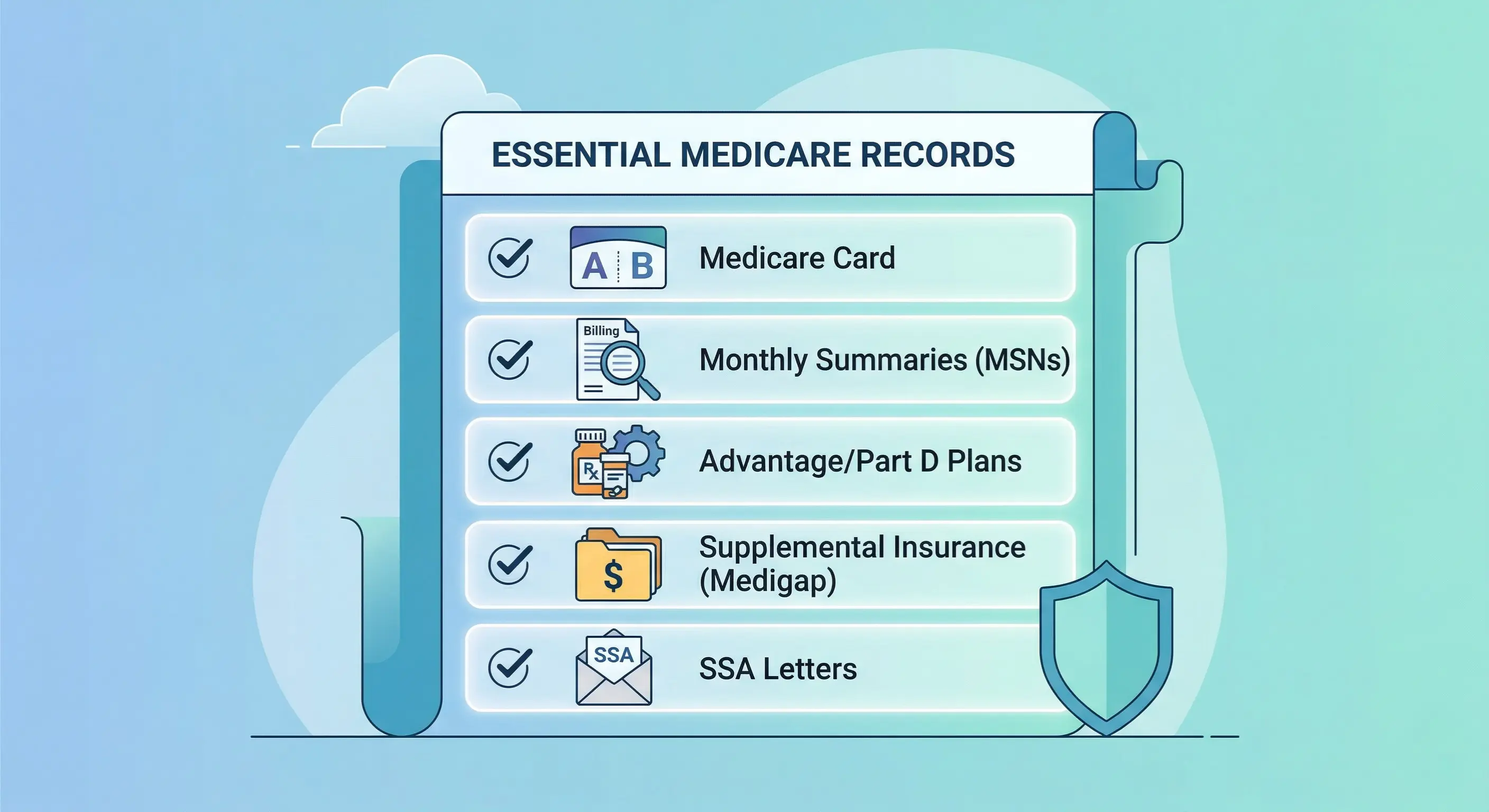
Keep these essential Medicare records organized:
- Your actual Medicare card (Part A and Part B)
- Medicare Summary Notices (MSNs) these are the monthly statements showing what they billed and what Medicare actually covered
- Enrollment docs for your Medicare Advantage or Part D plan
- Explanation of Benefits (EOB) from any Medigap or supplemental policies
- Letters from Social Security about your eligibility or premiums
- Paperwork for the Medicare Savings Program, if you use it
- Any records of fights or appeals with Medicare
Look, this isn’t just busywork. These papers prove you have coverage during an emergency. They help you spot billing fraud. They are totally necessary when you’re trying to coordinate care between three different doctors. If you end up in the hospital and your daughter needs to argue with the billing department, handing her these records will save her hours on hold and prevent massive bills.
Also, remember that Medicare Part B pays for a voluntary chat with your doctor about advance care planning. If you do this during your annual wellness visit, it shouldn’t cost you a dime out of pocket. Keep the notes from that conversation on file, too.
Living Wills and Advance Directives: The Documents That Speak When a Senior Cannot
Out of everything you could possibly organize, the living will is probably the most personal. It’s also the one document guaranteed to go missing right when everyone desperately needs it.
The University of Michigan’s National Poll on Healthy Aging found something pretty alarming: 54% of adults between 50 and 80 haven’t bothered with an advance directive or living will. So what happens? A medical crisis hits, and total strangers (doctors who just met the patient) or terrified family members have to make gut-wrenching decisions under crazy pressure.
A living will is just a legal paper that outlines what medical treatments you want if you can’t speak for yourself. A healthcare proxy (sometimes called a durable power of attorney for healthcare) officially names the person you trust to make those choices for you. The living will itself gets into the weeds about things like dialysis, ventilators, resuscitation, and feeding tubes.
And please don’t think this is only for the very old or the terminally ill. Car accidents and strokes don’t check your calendar. It is so much better to write a living will at 65 while you’re healthy than to try scraping one together at 85 in the ICU.
Make sure you store and share these key advance directive documents:
- The living will itself
- Durable power of attorney for healthcare
- Your POLST or MOLST form (Physician Orders for Life-Sustaining Treatment), if you have one
- The actual healthcare proxy paperwork
- Your written wishes regarding organ donation
- Copies of all this given to your primary doctor and any major specialists
Quick tip: if you’re a snowbird splitting time between two states, do yourself a favor and create an advance directive for both. Keep copies of both documents together in both houses.
The Common Thread: These Documents Are Useless If No One Can Find Them
A tax exemption that lapsed. A Medicare card buried in a shoebox under the bed. A living will locked tight in a safe that only grandpa knew the combination to. This exact nightmare plays out in living rooms across the country every single day.
The real goal here isn’t just printing out forms. It’s about locking them down somewhere secure, actually keeping them up to date, and making sure your trusted point person knows exactly where to look when the time comes.
That is exactly why platforms like InsureYouKnow.org exist. It’s a secure, encrypted digital safe deposit box. You can stash your vital records there, give access to the people you trust, and even set up nudges to review everything once in a while. Nobody wants to do paperwork just for fun. You do it for the peace of mind.
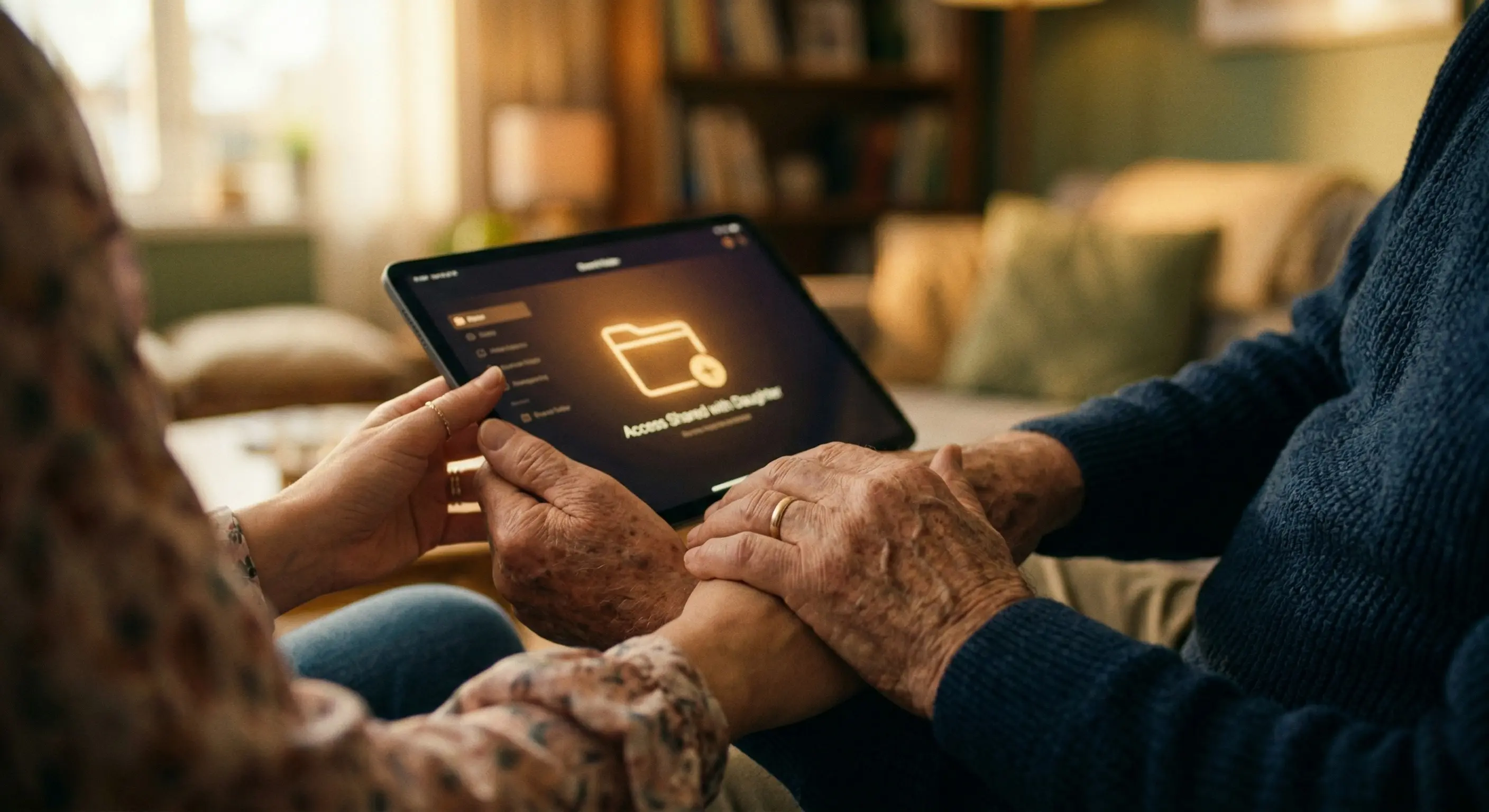
You do it so that when life throws a curveball, the right papers are in the right hands immediately.
Seniors and their families already have enough stress to deal with. Getting your records straight today basically guarantees you one less crisis tomorrow.
InsureYouKnow.org is a secure electronic safe deposit box for life’s most important information. The platform does not provide legal, financial, or insurance advice it helps ensure that the right people have access to the right documents when they need them most.
Medical ID Wallet Cards vs. Digital Access: Which is Better?
February 11, 2026
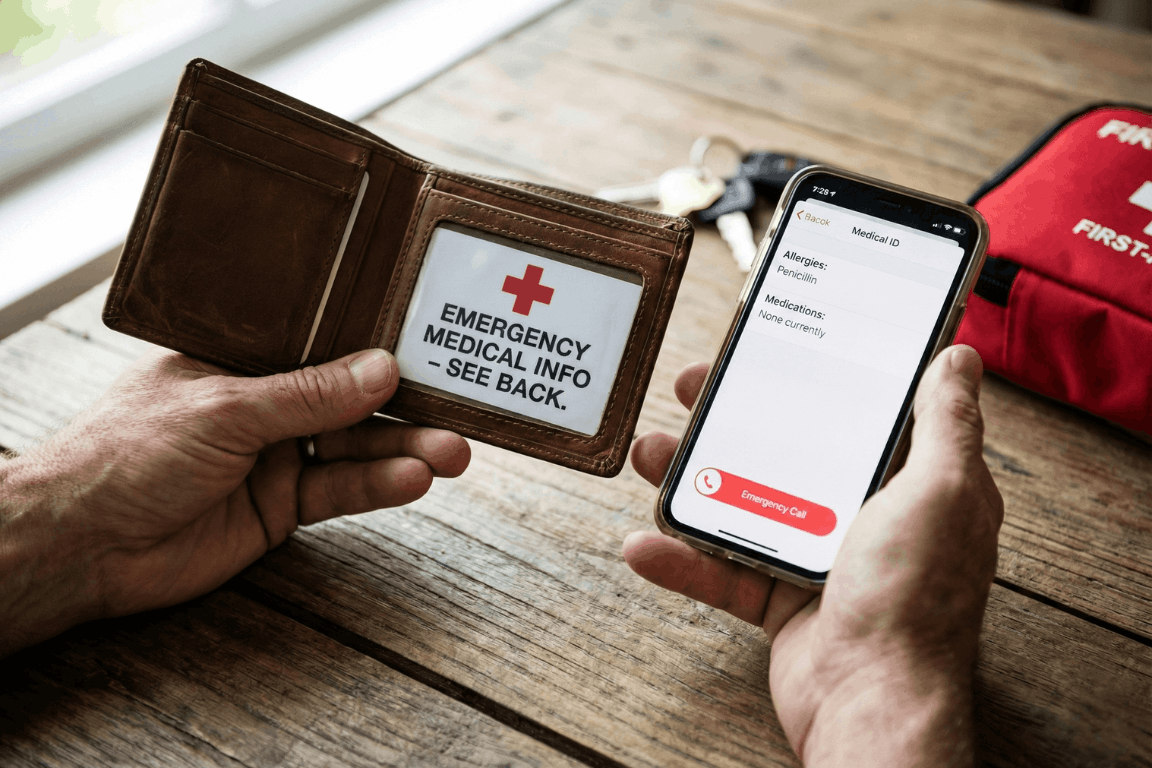
The Emergency Question
Picture someone collapsing in a store, unable to talk. Paramedics rush over but need answers. What allergies does this person have? What medications? Any serious health problems? Should these details live on a card in their wallet or sit on their phone?
Here’s the thing: picking just one isn’t the best move.
Medical ID Wallet Cards
Advantages
- Battery? What battery? These cards just work, period.
- First responders get it: About 95% of EMTs know to check wallets.
- Zero connectivity needed: Mountains, basements, middle of nowhere. Doesn’t matter.
- Won’t break the bank: Spend maybe $5-10 once, that’s it.
Disadvantages
- There’s only so much room on a tiny card.
- Wallets get misplaced or left at home sometimes.
- People forget to scratch out old info and add new stuff.
- Cards get wet, fade, or become hard to read after a while.
Digital Smartphone Medical IDs
Advantages
- Room for everything: Write down every single medication and condition.
- Updates take two seconds: New prescription? Changed doctors? Fixed instantly.
- Talks to 911: iPhones automatically send this stuff when someone dials emergency.
- Costs nothing: Already sitting in the phone waiting to be used.
Disadvantages
- Dead phone equals zero help.
- Some paramedics haven’t learned the tricks for every phone type yet.
- Accidents crack screens and destroy phones pretty often.
- Weird fact: Only about 1 in 4 people actually bother setting this up.
The Smart Choice: Use Both
- Medical Alert Jewelry: Get a bracelet stamped with the biggest health concern plus “SEE WALLET CARD”.
- Wallet Card: The most important stuff, right there in physical form.
- Digital Medical ID: Everything else stored on the phone (make sure it shows without unlocking).
- Backup Copies: Stick extras in the glove box, desk drawer, with Mom or a close friend. Consider using a secure digital vault like InsureYouKnow to store copies of medical cards, insurance information, and emergency contacts that family members can access when needed.
Quick Setup
Wallet Card:
- Write down allergies, health conditions, meds, who to call.
- Get it laminated so it lasts.
- Make a few copies.
iPhone:
- Open Health app → Find Medical ID → Turn on “Show When Locked”.
Android:
- Go to Settings → Look for Safety & Emergency → Switch on “Show on Lock Screen”.
Total time needed: about 10 minutes.
Real Examples
- Diabetic collapse: Woman’s wallet card listed her insulin information. Paramedics knew exactly what to do.
- Allergic reaction: Guy’s phone shattered during his fall. Good thing his wallet card mentioned that penicillin allergy.
- Lost senior: Older woman wandered off, couldn’t remember her name. Her iPhone Medical ID had her daughter’s number right there.
Who Needs This?
People dealing with:
- Health stuff like diabetes, seizures, heart trouble.
- Bad allergies that could turn dangerous.
- Pills they take every day.
- Pacemakers, implants, that kind of thing.
Common Mistakes
- Picking one method and ignoring the other.
- Setting it up once and never looking at it again.
- Leaving the lock screen access turned off on phones.
- Keeping it secret from family members.
The Bottom Line
Why choose? Wallet cards save the day when phones quit. Digital files hold way more detail than any card could. Together, they’ve got each other’s backs.
- Money spent: Less than fifty bucks
- Time invested: Ten minutes
- Potential payoff: Might literally save someone’s life
Action Steps
- Today: Get that phone Medical ID set up (takes 5 minutes).
- This week: Print out a wallet card (another 5 minutes).
- Twice a year: Check both and update anything that changed.
When things go wrong, having a backup plan makes all the difference.
Storing Everything Securely
Beyond wallet cards and phone apps, keeping digital copies of medical information in a secure vault ensures family members can access critical details during emergencies. Platforms like InsureYouKnow provide encrypted storage for medical records, insurance policies, medication lists, and emergency contacts. This creates another layer of protection, especially when someone needs to share information with multiple family members or caregivers.
Medical History Cheat Sheet: What ER Doctors Need
February 4, 2026

The “Golden Hour” Gap
The Emergency Room is a storm. Noise. Chaos. Speed. Doctors and nurses fight the clock. They chase the “Golden Hour.” That tiny window where fast action beats death.
But silence is the enemy. Ambulances dump patients who can’t talk. Shock takes over. Or they are out cold. In that high-pressure moment, a missing detail, a drug allergy, an old surgery, sends the team down the wrong road. That road ends badly.
Ask any ER staffer. They agree on one thing. A simple “cheat sheet” is the best tool a person can bring through those doors.
Why Memory Fails in a Crisis
People think they will remember. “I know my meds,” they say. They are wrong. Trauma wipes the brain clean. Pain and fear take over. A patient knows they take a “heart pill.” The name? Gone. The dose? Forgotten.
A written paper fixes this. It talks when the mouth cannot. It stops the guessing game between a frantic arrival and safe care.
The ER Doctor’s Wish List: 6 Essentials
What goes on the paper? Forget the thick file. Medical teams want facts. Facts that change the plan right now.
1. The “Big Picture” Demographics
Before the IV goes in, the team must know who they are treating. They need to know who signs the forms.
- Full Legal Name and Date of Birth: This finds old records in the computer.
- Blood Type: Vital for fast transfusions.
- Emergency Contacts: A spouse. A parent. Someone who answers “yes” or “no” to surgery when the patient can’t.
2. The Medication List (Crucial)
This part kills people if it’s wrong. Drug interactions cause huge messes in hospitals. Be exact:
- Prescription Drugs: The name. The dose (like 50mg). The schedule.
- Over-the-Counter (OTC) Meds: Aspirin. Ibuprofen. They seem safe. They aren’t. They thin blood. They hit kidneys.
- Supplements and Vitamins: Herbal pills often fight with anesthesia.
Note: Never write “Take as directed.” That tells the doctor zero.
3. The Allergy Alert
Does the patient hate penicillin? Latex? Contrast dye? The team needs to know. Now. The wrong drug turns a broken bone into a breathing emergency. List the allergen and the reaction. “Penicillin: Hives.” “Peanuts: Throat shuts.”
4. Past Medical History (PMH)
Context is king. A stomach ache in a healthy teen is one thing. In a Crohn’s patient, it’s another.
- Chronic Conditions: Diabetes. Asthma. Epilepsy. High blood pressure. Heart issues.
- Implants: Pacemakers. Metal rods. Artificial joints. The team must know this before an MRI scan starts.
- Past Surgeries: A quick list. “Appendectomy, 2015.” “C-Section, 2020.”
5. Recent History
Sometimes the clue is new. A note about travel, especially overseas, helps. So does a note about recent hospital stays. This helps doctors spot weird infections.
6. Insurance and Directives
Life comes first. But paperwork causes headaches later. List Insurance Policy and Group Numbers. Also, check for an Advance Directive or DNR (Do Not Resuscitate) order. A copy must exist. Otherwise, the patient’s wishes get ignored.
Paper vs. Digital: The Accessibility Problem
Old advice? Keep a card in a wallet. But paper sucks. It fades. It tears. It gets lost. Or it sits in a kitchen drawer while the car crash happens three towns over.
Digital vaults like InsureYouKnow.org changed the game. Storing this “Cheat Sheet” in a secure cloud keeps data safe. It stays ready. A trusted partner pulls up the vault on a phone. Seconds later, the ER team has the facts.
The Final Diagnosis
Being ready isn’t paranoia. It is smart. A Medical History Cheat Sheet takes ten minutes. It pays off in safety. It lets doctors work faster. It stops bad errors. And it gives families peace. They know the health story is clear. Even when the room is silent.
Sandwich Generation Guide: Organize Parents’ & Kids’ Records
January 8, 2026

The Squeeze is Real
The term “Sandwich Generation” sounds polite, almost clinical. But for the millions of adults living it, the reality feels a lot more like a pressure cooker. They are squeezed tight. On one side, there are children needing help with homework, permission slips, and growing pains. On the other, aging parents need support with doctors, medications, and a lifetime of accumulated paperwork.
It is exhausting.
The hardest part usually isn’t the physical caregiving. It is the administration. It is being the unpaid, overworked secretary for two different households. One minute, a parent is hunting for a vaccination card for summer camp; the next, they are frantically searching for Mom’s Medicare supplement number because a receptionist is waiting on the line.
When these worlds collide, chaos wins. Unless, of course, there is a system in place.
Two Households, One Overloaded Brain
The main problem isn’t a lack of effort. It is a lack of centralization. The “Sandwich” caregiver is trying to run two different operating systems at once.
Consider the children. Their documentation is constant and urgent:
- Social Security cards (usually lost in a drawer somewhere).
- Immunization records that schools demand every September.
- Birth certificates for sports or travel.
Then look at the parents. Their paper trail is decades long and much heavier:
- Wills, Trusts, and Deeds (often hidden in “safe” places that no one can find).
- Complex lists of daily medications.
- Insurance policies that need to be renewed.
- The dreaded “In Case of Emergency” contacts.
Keeping the kids’ files in a backpack and the parents’ files in a dusty filing cabinet across town simply doesn’t work. Not in 2026. When an emergency happens, and they always happen at inconvenient times, nobody wants to be driving across town to find a piece of paper.
The “Kitchen Table” Talk
Getting organized starts with a conversation, not a scanner. This is the tricky part. Many adults feel awkward asking their parents about wills or bank accounts. It feels intrusive.
But the conversation doesn’t have to be about control. It should be about safety. The approach matters. Framing it as, “We need to make sure the doctors know what you need if you can’t tell them,” works a lot better than, “Give me your passwords.”
The goal is strictly practical: preventing a crisis from becoming a disaster.
Cut the Clutter: What Actually Matters?
A common mistake is trying to save everything. But honestly, nobody needs to digitize a utility bill from 1998. To survive the squeeze, caregivers need to be ruthless about what they keep.
The “Must-Have” list is actually quite short:
- The Legal Shield: Power of Attorney. This is non-negotiable. Without it, an adult child is legally a stranger to their parent’s bank or doctor.
- The Medical Snapshot: A simple, updated list of what pills they take and who their primary doctor is.
- The Money Trail: Just a list of where the accounts are. Not necessarily the balances, but the locations of the banks and insurance policies.
Stop Relying on Physical Folders
Paper is fragile. It burns, it tears, and most importantly, it stays in one place.
If a parent falls ill while the caregiver is on vacation, that physical folder in the hallway closet is useless. This is why moving to a digital system is the only logical step for a modern family.
Using a secure, encrypted platform, like InsureYouKnow.org, solves the geography problem. It puts the information in the cloud, protected by encryption that is tougher than any lock on a filing cabinet. It means the right information is available on a smartphone, right in the hospital lobby, exactly when it is needed.
Don’t Go It Alone
There is a hero complex in the Sandwich Generation. Everyone tries to carry the load solo. But that is a recipe for burnout.
Once the records are digital, they should be shared. A spouse, a reliable sibling, or a family attorney needs access, too. Modern digital vaults allow for this kind of “trusted partner” access. It ensures that if the primary caregiver gets the flu or gets stuck in a meeting, someone else can step in and handle the situation.
Finding Some Peace
At the end of the day, organizing these records isn’t really about paperwork. It is about buying back time.
Every minute saved by not hunting for a lost insurance card is a minute that can be spent actually being a parent or a son or daughter. The paperwork will always be there, but the stress doesn’t have to be. By merging these two chaotic worlds into one secure place, the Sandwich Generation can finally take a breath.
How to Choose a Medical Power of Attorney and Stay Prepared
November 6, 2025

A few years ago, a close friend of mine went through something that completely changed how I look at “being prepared.” Her dad had a stroke while working in the garden. One minute he was watering plants, the next, he was in the hospital, unable to speak. The doctors were asking who could make medical decisions for him, but no one had an answer. Everyone froze.
It was heartbreaking to watch. Her mom was in shock, her siblings were arguing, and everyone was scared. Nobody knew what he would have wanted.
That day taught me something that I’ll never forget. Planning ahead isn’t just about being responsible. It’s an act of love. And that’s exactly what a Medical Power of Attorney is all about.
What a Medical Power of Attorney Really Means
A Medical Power of Attorney (MPOA) sounds like a complicated legal thing, but it’s actually simple. It’s a document that lets you choose someone you trust to make healthcare decisions if you can’t.
That person, your agent, doesn’t suddenly take over your life. They only step in if you can’t speak for yourself. Their role is to protect your wishes and make sure what you want actually happens.
It’s one of those things we tend to put off, but once it’s done, it brings a quiet kind of comfort. You know things will be okay, even if you can’t explain what you want in the moment.
Why It Matters
If you don’t have a Medical Power of Attorney, hospitals usually turn to whoever’s nearby or follow state laws about next of kin. That can work, but it can also cause a lot of tension. In stressful moments, people don’t always think clearly. They guess, they argue, they panic.
Having an MPOA avoids all that. It gives doctors one clear person to speak with and gives your family direction when things feel uncertain. It’s a simple form, but it can prevent a lot of heartache later.
How to Choose the Right Person
Choosing your agent isn’t about who’s closest to you. It’s about who knows you best. The person you trust most doesn’t have to be family. It could be a friend, a sibling, or someone who simply understands you.
Here’s what to think about:
- Who stays calm under pressure?
- Who knows how you feel about medical care and quality of life?
- Who will listen to doctors carefully and ask good questions?
- Who will do what you want, even if others disagree?
Once you decide, talk to them. It doesn’t need to be formal or serious. Maybe just bring it up during a car ride or while cooking dinner. Tell them how you feel about certain treatments or what kind of care you’d want. These honest conversations matter so much more than any form.
Keeping Your Documents in Order
Once your form is signed, keep it somewhere easy to find. In an emergency, no one wants to dig through stacks of paper.
Here’s what to keep together:
- Your MPOA form (signed and dated).
- A Living Will or Advance Directive describing your medical preferences.
- A HIPAA release form so your agent can speak with doctors.
- Health insurance cards and policy info.
- Emergency contacts for family and doctors.
- Photo IDs for you and your agent.
I like to keep mine in a labeled folder at home and another copy saved online. It’s one of those “just in case” things that saves everyone stress later.
Why Digital Storage Helps
Paper gets lost. It gets packed in a box or tossed by accident. That’s why having a digital copy is smart.
A secure site like InsureYouKnow.org makes it easy to upload and store important documents safely. You can label them, share access with your agent, and know that if you ever need them, they’re right there. It’s simple, private, and safe.
It’s not about being tech savvy, it’s about being practical.
Keep It Updated
Life changes. People move, relationships shift, new doctors come into your life. Once a year, take five or ten minutes to check that your MPOA and other forms are still up to date.
It doesn’t take long, but it gives you peace of mind that everything’s current.
A Final Thought
Setting up a Medical Power of Attorney isn’t about expecting bad things to happen. It’s about kindness, for yourself and the people who love you.
Once it’s done, you can stop worrying. You’ll know that, no matter what happens, your family won’t be left guessing. They’ll already know because you cared enough to prepare.
It’s not just a document. It’s peace of mind, and maybe one of the most loving things you can do.
The Mental Health Gap: What Parents Miss and Teens Need
September 1, 2025

Your teen says they’re fine. But they’ve stopped texting friends, spend more time in their room, and their grades are slipping. Could you spot the signs if they were struggling? Only 58% of U.S. teenagers feel they get the emotional support they need—yet 93% of parents believe they’re providing enough.
Findings like these show that parents may not always realize when their child is struggling. Young people today face different challenges than their parents and previous generations did. More than ever, parents must understand the unique pressures young people are struggling with today.
Challenges Faced by Teens
Nearly 10% of all U.S. kids aged 3 to 17 experience anxiety, while 5% live with depression. A few causes are listed below:
- Many young people are dealing with packed schedules, the pressure to succeed in academics, sports, and extracurriculars, and the uncertainty of what comes after graduation. The pressure to excel can lead to burnout.
- With in-person learning, the fear of school shootings can create a general sense of day-to-day unease.
- Students who remember the pandemic lockdown may have posttraumatic stress from virtual learning and social isolation.
- Social media has introduced young people to near-constant comparison, leading to low self-esteem. Body dissatisfaction is leading to a rise in eating disorders.
- Concerns over climate change can also lead to feelings of hopelessness.
Warning Signs
As a parent, you have a good sense of what your child’s “normal” looks like. In addition to the more striking symptoms, such as mood swings, angry outbursts, or being more tearful than usual, you may notice:
- Changes in eating habits, weight, sleep, or other routines
- Loss of interest in the things they once enjoyed or quitting activities
- Withdrawing from close friends or family
- Academic struggles that seem different or more intense, such as a refusal to complete assignments
- Becoming more visibly worried or expressing constant worry
- Any signs of substance abuse or evidence of self-harm, such as cuts, burns, or bruises
Just because your child exhibits any of these symptoms does not mean they are experiencing a mental health crisis. Biological changes, including hormonal shifts that all teenagers must go through, can affect their mood and school performance.
“It’s kind of hard because these things correlate with puberty,” says Theresa Nguyen, vice president of policy and programs at Mental Health America. “It gets hard for parents because this period of time is so muddy.”
Converse Differently
Checking in with your child is an ongoing process, not a one-time occurrence. Normalizing regular conversations with your child supports their mental health and also gives them the foundation to come to you when they need help.
Kids avoid touchy subjects, especially if they fear being lectured or punished. Make sure your children know they can come to you with anything. Create a safe space for them by remaining approachable and nonreactive. Routine moments, such as car rides or dinner times, can be opportunities for discussion.
Avoid forcing conversations or asking direct questions like, “What’s wrong?” Instead, ask about specific things at school or what they might be looking forward to. They will be more willing to open up if they do not feel interrogated. Try listening more than you speak and resist the urge to give advice immediately.
The goal is not to fix everything for them, but to make sure they know they are supported. “As parents, our instinct is often to jump in with advice, but it’s very rare that that’s what teens are looking for,” says Lisa Damour, a clinical psychologist. “Teenagers often feel supported not through a conversation but through our steady presence. It’s about being around and available.”
Parents can show their teen how to care for their mental health by modeling those healthy behaviors themselves.
- Encourage good physical habits. Eat well and encourage exercise, both of which can be activities you do together. Every family member should have a bedtime and sleep routine.
- Limit screen time and social media. If your teen is resistant, approach it together as an experiment to see if it’s beneficial to take a break.
- Find activities that you enjoy and help them do the same. Ideally, you can find a few things to enjoy together, such as going for walks or watching movies.
“Lead by example,” advises Nguyen.
Your child’s pediatrician can help with any mental health concerns. They can explain treatment options, including medication, and refer you to a specialist for evaluation. Talking with a licensed mental health professional, for instance, can provide teens with a safe and judgment-free zone to process emotions and develop coping skills.
Your child’s care team can develop a crisis plan involving the steps to take if symptoms worsen. There are also courses for parents who want to learn more about mental health first aid. Teens who need to speak with someone immediately may always call The 988 Suicide & Crisis Lifeline or text “TALK” to 741741.
By staying organized, parents can create more time for family. “The single most powerful force for adolescent mental health is strong relationships with caring adults,” says Damour.
Your teen doesn’t need you to have all the answers. They just need to know you’re there every day, without conditions.
At Insureyouknow.org, parents may keep track of their child’s schedule, medical records, and other essential documents.
Intergenerational Care Benefits Everyone Involved
September 29, 2024

September is Intergeneration Month, launched by The Intergenerational Foundation, to connect generations and urge people from varying age groups to socialize. The idea behind recognizing Intergeneration Month each September is to promote learning from each other, such as gaining a better understanding of history and the challenges that separate generations. By connecting with different age groups across generations, unlikely friendships form between those who would otherwise never have communicated with each other.
People balancing raising young children and caring for aging parents may consider looking into what intergenerational daycare can offer. Facilities that provide both child care and senior care are on the rise, and that’s probably because, in addition to being a convenient solution for caretakers, the benefits to each age group are numerous.
If you’re considering Intergenerational Care for your loved ones, here’s everything you need to know.
What is Intergenerational Care?
Intergenerational care centers provide care for both young children and older adults. “It’s also referred to as a ‘shared site,’” says Merle Griff, the director of McKinley Center Intergenerational Project. “In many cases, there’s a senior area on one side of the building, a child care area on the other, and a hallway connecting the two. At various points during the day, they come together,” she says. The care provided can take on several forms, but at the core, it’s a service offered to multiple generations to provide care in one place across age groups.
The benefits of multi-generational care include forming connections between people who have a lot to teach one another and who would have otherwise never been allowed to meet. “It brings younger and older people together to increase social connectedness, enhance well-being for the benefit of all ages, and strengthen the web of support that is so integral to families and communities,” says Sheri Steinig, the director of Generations United. “People of different ages come together to learn, play, grow, and interact in planned intergenerational activities as well as through informal encounters,” she says.
The Different Kinds of Intergenerational Care
While intergenerational care means care across generations, the services provided vary. “There are many settings for intergenerational care,” says Steinig. “There can be programs at community centers and schools or care in daycare centers, retirement communities, nursing homes or assisted living and affordable housing,” she says. You may even provide intergenerational care in the form of a multigenerational household where more than two generations live. One in four American households are already multigenerational.
Intergenerational care centers look more like daycare facilities with adult daycare services or nursing home locations. “Each center is run their own way,” says Griff. “There are typically planned, structured interactions during the day,” she says. Both age groups are usually not combined for the entire day. Daily intergenerational activities may look like a combined sport, arts and crafts activity, comparison presentations between then and now, or even cradling opportunities, where seniors are paired with infants to rock and soothe to sleep. To date, there are fewer care centers than intergenerational programs. While there are only 150 sites across the country, care centers are expected to grow in popularity. For instance, The Mount Intergenerational Learning Center, a Seattle preschool within a nursing home, reports having over 400 children on their waiting list.
Intergenerational care programs are structured pairings between children of various ages and older adults. Programs such as these are designed to foster relationships between youth and seniors. It could be a pen pal program between elementary school kids and seniors, college students visiting nursing homes, multi-age choirs, or veterans going to schools to talk to students about their experiences.
To find a program such as this or a care center in your area, Generations United offers a search tool.
The Benefits of Intergenerational Bonds
Many grandparents live thousands of miles away from their grandchildren while aging adults live several states away from their children. According to a study from the University of California San Francisco, 43% of older adults report experiencing loneliness, and those who feel lonely are at a 59% increased risk of declining health.
That’s when intergenerational care can help. Older adults experience a sense of purpose and renewal after spending time with and helping young people. It helps seniors feel like they are not just receiving care but offering care. “Despite the dementia diagnosis, the maternal and paternal instincts can still kick in, and the seniors feel a sense of purpose,” says Jenna Hauss, the president of ONEgeneration. “They can care for others. They don’t always need to be cared for,” she says.
It isn’t just older generations that benefit from the connection. Children who spend time around older adults have fewer biases around such things as walkers and wheelchairs and become more comfortable with these differences. Multigenerational care promotes sensitivity among both age groups. Parents notice that their children are more empathetic, while older adults experience less loneliness, reduced agitation, and improved overall health.
Intergenerational care addresses two important needs: early childcare and the increasing demand for senior services, but the benefits of this combined service reap rewards far beyond caretaking. Research is proving that both age groups experience different perks from intergenerational connections. If this sounds like it might be the right fit for you and your loved ones, Insureyouknow.org can help you search for care by storing all of your research, financial information, and medical records in one easy-to-review place.
Understanding What Hospice Care Means
July 1, 2024

When treatment for serious illnesses is causing more side effects than benefits, or when health problems become compounded, then a patient and their family members may begin to wonder about hospice. “We recognized as people consider hospice, it’s highly emotional times,” says medical director for Austin Palliative Care Dr. Kate Tindall. “It might include worries and fears.” But one of the things she hears most often from patients and their families is that they wish they had started sooner. Understanding who qualifies for hospice and what it entails is the first part of deciding what might be best for those with terminal conditions.
What is Hospice Care?
Hospice is meant to care for people who have an anticipated life expectancy of 6 months or less, when there is no cure for their ailment, and the focus of their care shifts to the management of their symptoms and their quality of life. With hospice, the patient’s comfort and dignity become the priority, so treatment of the condition ends and treatment of the symptoms, such as pain management, begins. There are no age restrictions placed around hospice care, meaning any child, adolescent, or adult who has been diagnosed with a terminal illness qualifies for hospice care.
An individual does not need to be bedridden or already in their final days of life in order to receive hospice care. Other common misconceptions about hospice care are that it is designed to cure any illness or prolong life. It is also not meant to hasten death or replace any existing care, such as those already provided by a physician.
Determining When it’s Time for Hospice
Establishing care is most beneficial for the patient and their caregivers when it is taken advantage of earlier rather than later. Hospice can be used for months as long as eligibility has been met. Once there is a significant decline in physical or cognitive function, the goal for treatment should become to help that individual live comfortably and forgo anymore physically debilitating treatments that have been unsuccessful in curing or halting the illness.
Both individuals and their loved ones who would benefit from initiating hospice care are often unaware of the services or are uncomfortable asking about them. “It’s a hard conversation to have,” says professor of medicine and palliative care at the Duke University School of Medicine David Casarett. “Many people really want to continue aggressive treatment up until the very end.” While many wait for their providers to suggest it, it should be understood that if eligibility for hospice has been met, an individual and their caregivers can initiate hospice care on their own.
Establishing Hospice Care
In order to qualify for hospice care, a physician must certify that the patient is medically eligible, which means that the individual’s life expectancy is 6 months or less. Typically, the referral to hospice starts with the attending physician’s knowledge of that person’s medical history, while eligibility is then confirmed by the hospice physician. A hospice care team consists of professionals who are trained to treat physical, psychological, and the spiritual needs of the individual, while also providing support to family members and caregivers. Care is person-centered, with the importance being placed on the coordination of care, setting clear treatment goals, and communicating with all involved parties.
Receiving Care at Home
Hospice care is generally provided in the person’s home, whether it’s a personal residence or a care facility, such as a nursing home. “When people are close to the end of their lives, going to the hospital does not make them feel better anymore,” explains professor of medicine at the University of California Dr. Carly Zapata. “Because there’s not necessarily something that we can do to address their underlying illness.” Staying at home allows the individual to be around their personal things and close to their loved ones and pets, which can provide them with comfort during the end of their life.
What Does Hospice Care Include?
Hospice includes periodic visits to the patient and their family or caregivers but is available 24-7 if needed. Medication for symptom relief is administered, any medical equipment needed is provided, and toileting and other supplies such as diapers, wipes, wheelchairs, hospital beds are provided. What may surprise some people is that hospice patients may even receive physical and occupational therapy, speech-language pathology services, and dietary counseling.
If needed, short-term inpatient care may be established for those who cannot achieve adequate pain and symptom relief in their home setting. Short-term respite care may also become available to help family caregivers who are experiencing or are at risk for caregiver burnout. Bereavement care, or grief and loss counseling, is also offered to loved ones who may experience anticipatory grief. Grief counseling is available to family members for up to 13 months after the person’s death.
Paying for Hospice
The first step in finding a hospice agency is to search for ones that serve your county. If there are several options available, then it’s recommended to talk to more than one and see which agency will best fit the patient’s needs. Adequate research should be conducted since not all hospice agencies provide physical and occupational therapy.
Hospice is a medicare benefit that all Medicare enrollees qualify for, but it may also be covered through private insurance and by Medicaid in almost every state. Military families may receive hospice through Tricare, while veterans with the Veterans Health Administration Standard Medical Benefits Package are also eligible for hospice. Hospice agencies will also accept individual self-pay, while there are also non-profit organizations that provide hospice services free of charge.
Discontinuing Hospice Care
Though it is uncommon, if a patient does improve or their condition stabilizes, they may no longer meet medical eligibility for hospice. If this happens, the patient is discharged from the program. Another situation that sometimes arises is when a person elects to try a curative therapy, such as a clinical study for a new medication or procedure. In order to do that, the patient must withdraw from hospice through what is called revocation. Both children and veterans are exempt from being disqualified from hospice care if they choose to also pursue curative treatments. Any person may always re-enroll in hospice care at any time as long as they meet the medical eligibility.
Opting for Palliative Care
Individuals with chronic conditions or life-threatening illnesses may opt for palliative care, which doesn’t require people to stop their treatments. Palliative care is a combination of treatment and comfort care and can be an important bridge to hospice care if patients become eligible. Because transitioning to hospice care can be an emotional choice, palliative care providers often help patients prepare for that. Many people avoid palliative care because they think it is equal to giving up and that death is imminent, but studies show that for many, palliative care allows them to live longer, happier lives. This is due to the benefits of symptom management and spiritual support.
While hospice care can be difficult to accept, it can provide people with the best quality of life possible in their final days, as well as provide their loved ones with valued support. With Insureyouknow.org, you may keep track of all medical and financial records in one easy-to-review place so that you may focus on caring for your loved one, your family, and yourself during this period of their care.
Life After a Stroke: What You Should Know
May 21, 2024
A stroke affects the brain’s arteries and occurs when a blood vessel that brings blood to the brain gets blocked or ruptures. The area of the brain that is supplied with blood by the blocked or ruptured blood vessel doesn’t get the oxygen and nutrients it needs, and without oxygen, nerve cells are unable to function. Since the brain controls one’s ability to move, feel, and think, a stroke can cause injury to the brain that could affect any or all of these functions.
Everyone should know the signs of a stroke and seek immediate medical attention if you think you or someone around you is having a stroke. If you or someone you love has recently had a stroke, then it’s important to understand what happens next.
Know the Symptoms of a Stroke and act FAST
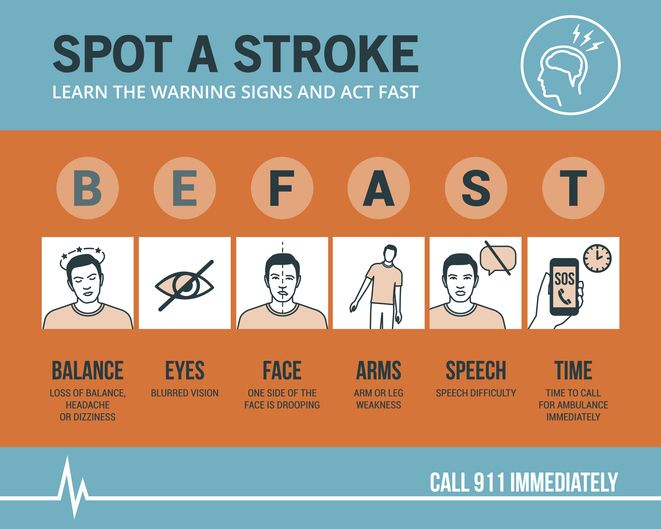
The longer the brain is left untreated during a stroke, the more likely it is that someone will have irreversible brain damage. The acronym FAST can help everyone recognize the four main signs that someone may be having a stroke and remember to act fast in seeking medical treatment. That means calling 9-1-1 immediately, as emergency response workers can treat someone on arrival if they think that person is having a stroke.
FAST stands for Facial drooping, Arm weakness, Speech difficulties, and most importantly, Time. If one side of a person’s face is drooping, if the person cannot lift both arms or one arm is drifting downward, and if the person’s speech is slurred or they cannot repeat a simple sentence, then they may be having a stroke. Not all of these signs need to be present to signal a stroke. Just one or two of these symptoms is enough to call 9-1-1, because time is of the essence in the event of a stroke.
Stroke Treatment Begins With Emergency Response Workers
Calling for an ambulance means that the emergency response workers can start life-saving treatment on the way to the hospital. Stroke patients who are taken to the hospital in an ambulance may get diagnosed and treated more quickly than people who wait to drive themselves. The emergency workers may also know best where to take someone, such as to a specialized stroke center to ensure that they receive the quickest possible treatment. The emergency workers can also collect valuable information for the hospital medical staff before the patient even gets to the emergency room, alerting staff of your arrival and allowing time to prepare. All of what the ambulance team can provide saves time in the treatment of stroke, and in the event of a stroke, time is of the essence.
Ischemic Stroke or Hemorrhagic Stroke?
There are two different kinds of stroke, ischemic or hemorrhagic. A medical team will need to determine which kind of stroke the patient is having in order to direct treatment. An ischemic stroke accounts for 87% of all strokes and happens when a blood clot blocks a vessel supplying blood to the brain. Hemorrhagic stroke happens when a blood vessel ruptures and bleeds within or around the brain.
“Fifty percent of strokes present with a clot in a large vessel in the brain, and these don’t respond very well to the old treatment, the IV clot busting medicine,” says M.D. and director of the Sparrow Comprehensive Stroke Center Anmar Razak. “And so nowadays, we do surgery, and what we do is we rush them into the hospital, into the cath lab. We quickly get access through the blood vessels and get up to where the clot is and pull it out.”
With ischemic stroke, the treatment goal is to dissolve or remove the clot. A medication called alteplase or tPA is often administered and works to dissolve the clot and enable blood flow. Alteplase saves lives and reduces the long-term effects of a stroke but must be given to the patient within three hours of the start of a stroke. Then, a procedure called mechanical thrombectomy removes the clot and must happen within six to 24 hours of stroke symptom onset.
For hemorrhagic stroke, the treatment goal is to stop the bleeding. There is a less-invasive endovascular procedure involving a catheter being threaded through a major artery in an arm or leg toward the area of the bleeding in the brain where a mechanism is inserted to prevent further rupture. In some cases, surgery is required to secure the blood vessel that has ruptured at the base of the bleeding.
Rehabilitation After a Stroke
Perhaps the most important part of stroke treatment is determining why it happened or the underlying causes of the stroke. Stroke risk factors include high blood pressure, which weakens arteries over time, smoking, diabetes, high cholesterol, physical inactivity, being overweight, heart disease including atrial fibrillation or aFib, excessive alcohol intake or illegal drug use, and sleep apnea. By making the right lifestyle choices and having a good medical management plan moving forward, the risk of another stroke can be greatly reduced.
That’s because if you have had a stroke, you are at high risk for having another one. One in four stroke survivors have another within five years, while the risk of stroke within 90 days of transient ischemic attack or TIA is as high as 17% with the greatest risk during the first week. This is why it becomes so important to determine the underlying causes of the initial stroke. Your doctor may give you medications to manage a condition, such as high blood pressure, and then recommend lifestyle changes, including a different diet and regular exercise.
Rehabilitation after a stroke begins in the hospital, often within only a day or 2 after the stroke. “There are so many things that patients need to fall into place to be functional and independent again after a stroke,” said Razak. “And they always come down to speed and time.” Rehabilitation can help with the transition from the hospital to home and can help prevent another stroke. Recovery time after a stroke is different for everyone and can take weeks, months, or even years. Some people may recover fully, while others may have long-term or lifelong disabilities. Stroke rehabilitation should be thought of as a balance between full recovery and learning how to live most effectively with some deficits that may not be recovered.
Difficulties from a stroke range from paralysis or weakness on one or both sides of the body, fatigue, trouble with cognitive functioning such as thinking and memory, seizures, and mental health issues like depression or anxiety from the fear of having another stroke. Everyone’s rehabilitation will look different based on their difficulties after a stroke but may include speech, physical, and occupational therapy. Speech therapy helps when someone is having problems producing or understanding speech, physical therapy uses exercises that help someone relearn movement and coordination skills, and occupational therapy focuses on improving daily activities, such as eating, dressing, and bathing. Joining a patient support group may help people adjust to life after a stroke, while support from family and friends can also help relieve the depression and anxiety following a stroke. It’s important for stroke patients to let their medical team and loved ones know how they’re feeling throughout their recovery and what they may need help with.
Stroke rehabilitation can be hard work, but just as in the initial treatment of a stroke, time matters in the possibility of a full recovery. Many survivors will tell you that rehabilitation is worth it and recommend using motivators to achieve recovery goals, such as wanting to see a child’s graduation or returning to working in the garden. With Insureyouknow.org, caretakers may keep track of medical treatments and rehabilitation plans in one easy-to-review place so that they may focus on caring for their loved one during the period of recovery from stroke.
May is American Stroke Month which aims to raise awareness of the second leading cause of death.